 28 June 2026
1 June - 28 June 2026
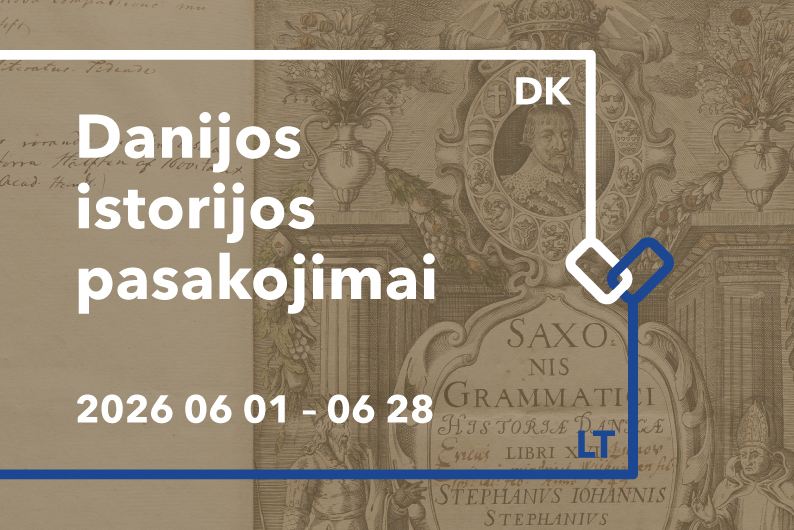
To celebrate the 35th anniversary of Denmark’s decision to recognize Lithuania’s restored independence, the National Library of Lithuania – in collaboration with the Embassy of the Kingdom of Denmark in Lithuania and the Danish Cultural Institute in Estonia, Latvia, and Lithuania – is organizing a series of events titled “A Year with Denmark”. As part of this series, the single-exhibit exhibition “Stories of Danish History” invites visitors to explore Denmark's past through historical texts and imagery.
In the 12th century, the Danish historian and chronicler Saxo Grammaticus (~1150–1220) authored one of the most significant historical works of Scandinavia – “Gesta Danorum”. It recounts the history of Denmark from legendary times to the Middle Ages, featuring iconic figures such as Ragnar Lodbrok, Hasting, Roric, and Haakon. Considered one of the first coherent narratives of Danish history, the work became a foundational source for both historians and the literary tradition.
In the 17th century, the work was reissued as “Historiae Danicae libri XVI”, edited by the Danish historian Stephen Hansen Stephanius (1599–1650). Beyond editing the text, he supplemented it with extensive commentary published in appendix, “Notae uberiores in historiam Danicam Saxonis Grammatici”. Stephanius had an ambitious goal: to reconcile narrative history with material evidence. Consequently, the edition is filled with engravings of runestones.
Runes are the oldest Germanic writing system, used in Scandinavia long before the Latin alphabet took hold. The engravings of these inscriptions allow us to glimpse the past through both text and physical artifacts. A primary example is the town of Jelling in Denmark, home to the famous runestones often called the “baptismal certificate” of Denmark. They were erected by King Harald Bluetooth (10th c.) to memorialize his parents, Gorm and Thyra, and to proclaim the unification of Denmark, the conquest of Norway, and the conversion of the Danes to Christianity.
This work is also vital for the Baltic region. It describes Danish expeditions into Prussian lands (specifically Sambia) as well as conflicts with Estonians, Curonians, and Semigallians. “Gesta Danorum” remains one of the earliest sources testifying to the contact between the Nordic countries and Baltic tribes – detailing both military actions and trade relations. These accounts provide a deeper understanding of regional history prior to the formation of later states.
Today, “Historiae Danicae” allows us not only to read history but to see it – revealing how 17th-century scholars sought to understand and substantiate the past by merging text, imagery, and material evidence.
We invite you to visit the single-exhibit exhibition in the atrium on the third floor of the National Library, next to the sculpture of Martynas Mažvydas, from June 1 to June 28.
The exhibition organizer is Kasparas Svitojus, the exhibition artist is Jokūbas Zovė.